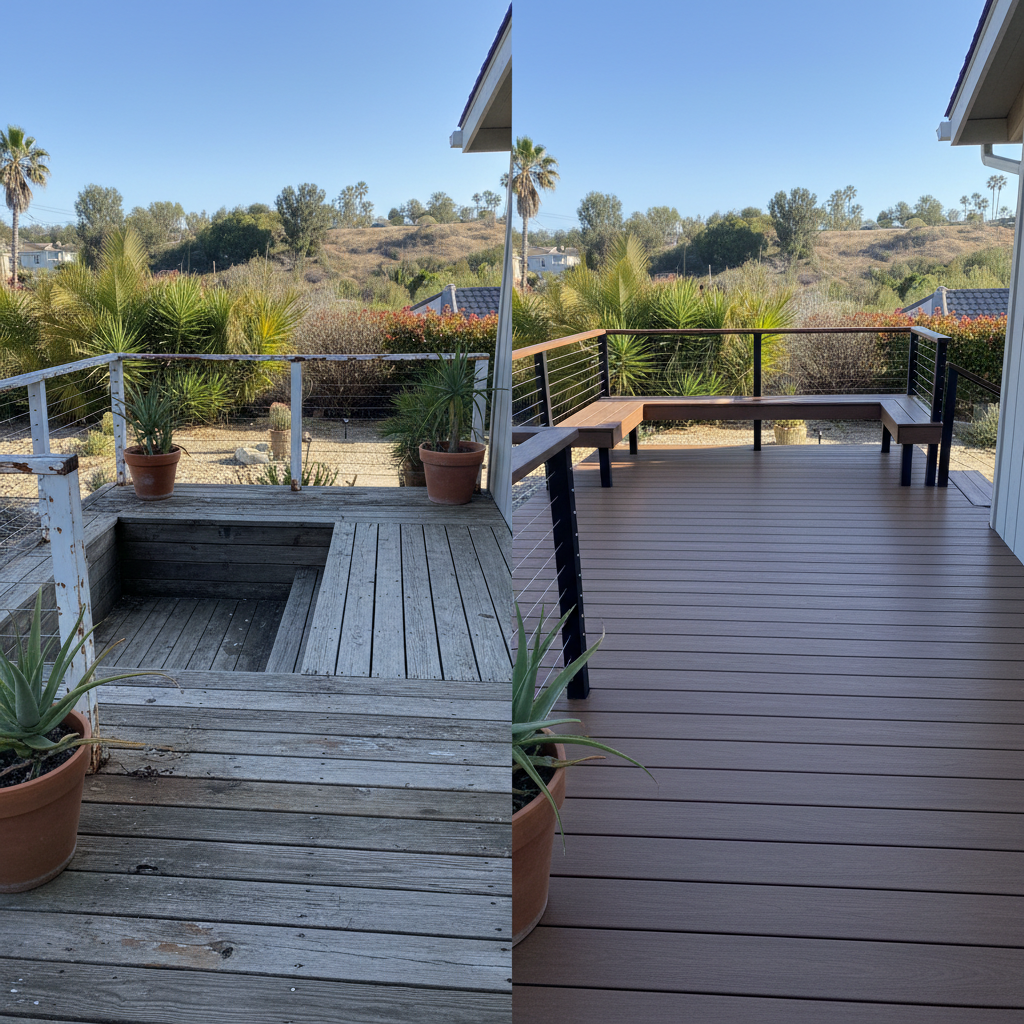
So, you're looking at composite decking for your Encinitas home. Smart move. It's a fantastic alternative to wood, especially with our coastal climate. But once you start digging, you'll quickly realize it's not just 'composite.' There's a big distinction you need to understand: capped versus uncapped composite decking.
What's the Big Deal? Capped vs. Uncapped
Think of it like this: uncapped composite is the original recipe. It's a blend of wood fibers and plastic, pressed together. Capped composite takes that original core and adds a durable, protective layer – a 'cap' – made of a different, usually more resilient, plastic material. This cap completely encases the core on at least three sides, sometimes all four.
Why does that matter? It matters a lot, especially here in Encinitas where we get that strong sun and occasional marine layer.
Durability: Who Wins the Weather Battle?
Uncapped composite, while more durable than natural wood, still has its vulnerabilities. Because the wood fibers are exposed, even slightly, it can absorb moisture. Over time, that can lead to mildew, staining, and even some fading. You might see it start to look a little chalky or dull after a few years, especially if it's in a spot that gets a lot of direct, unfiltered sun, like a south-facing deck in Olivenhain.
Capped composite, on the other hand, is a tank. That protective cap acts like a shield. It's engineered to resist fading, staining, scratching, and moisture absorption. I've seen capped decks look practically brand new after ten years, even with kids and pets running all over them. The cap is usually made from a high-performance polymer that's much more stable than the composite core.
Maintenance: Less Work, More Play
This is where capped composite really shines, and frankly, it's why most of my clients choose it. With uncapped, you'll need to clean it regularly to prevent mildew and stains. Sometimes, you might even need a light pressure wash, but you have to be careful not to damage the surface. If you spill red wine or BBQ sauce, you need to get to it fast, or it's probably going to leave a mark.
Capped composite? It's almost set-it-and-forget-it. A quick sweep, maybe a hose-down with some soap and water once in a while, and you're good. That cap is incredibly resistant to stains. I've seen coffee, grease, and even sunscreen wipe right off without a trace. For busy homeowners, or anyone who just wants to enjoy their deck instead of working on it, this is a huge advantage.
Appearance: The Look and Feel
Early uncapped composites often looked a bit artificial, sometimes with a slightly plasticky sheen. They've improved, but they still tend to have a more uniform, less natural look. The color options were also a bit more limited.
Capped composites have come a long, long way. Manufacturers like Trex and TimberTech have invested heavily in making them look incredibly realistic. They often have multi-tonal streaking, deep wood grain patterns, and matte finishes that mimic natural wood beautifully. You can get them in a huge range of colors, from rich browns to cool grays, and they hold their color much better over time thanks to that UV-resistant cap. They also tend to feel more substantial underfoot.
Cost: The Upfront Investment
Okay, let's talk money. Uncapped composite is generally less expensive upfront. You're looking at a lower material cost per linear foot. If budget is your absolute top priority and you're willing to put in a bit more elbow grease for maintenance, it might seem appealing.
However, capped composite will cost you more initially. It's a premium product, and that advanced technology and durability come with a higher price tag. But here's the thing: when you factor in the reduced maintenance over the life of the deck, the fact that it holds its value and appearance much better, and the sheer peace of mind, that upfront cost often evens out, or even comes out ahead, in the long run. You're paying for superior performance and longevity.
My Recommendation for Encinitas Homeowners
Given our specific conditions here in Encinitas – the strong sun, the occasional salt air, and let's be honest, most of us want to spend our weekends at the beach or on the trails, not scrubbing our decks – I almost always recommend capped composite decking.
It's simply a better investment for this environment. It handles the sun, resists mildew from the marine layer, and stands up to everyday life without fuss. You'll get more years of beautiful, low-maintenance enjoyment out of it. Yes, it's a bigger initial investment, but it's one that pays dividends in durability, appearance, and your free time.
If you're still not sure, or you want to see some samples and talk through your specific project, give me a call at Peak Deck Solutions. We can walk you through the options and help you pick the perfect composite for your Encinitas outdoor living space.